

24 09 2026 13:06
News Code : 275634312
View Count : 290
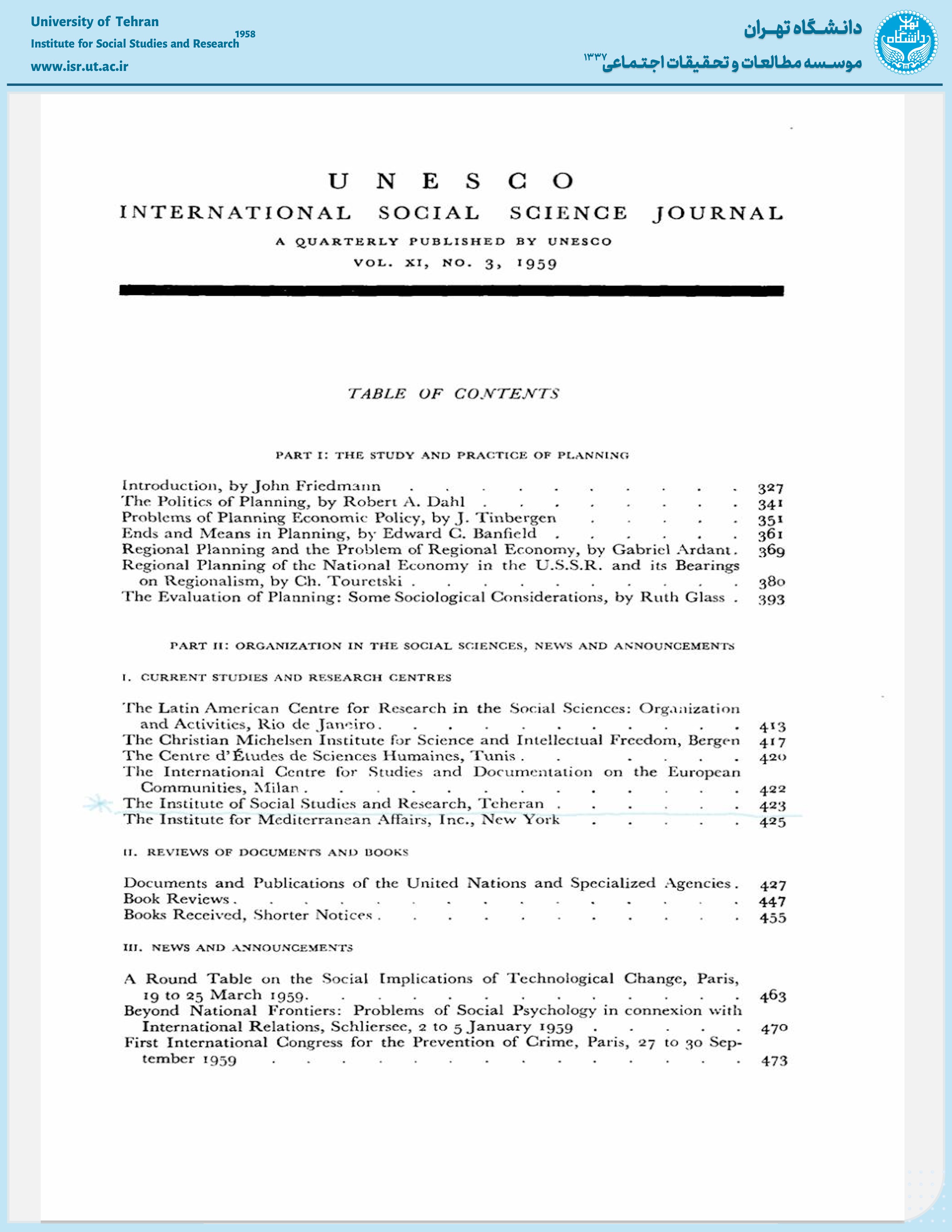
In a report published during the Institute’s first year of operation, UNESCO described the Institute of Social Studies and Research at the University of Tehran as an educational and research institution that, from its inception, combined teaching in the social sciences with applied research on issues facing Iran (UNESCO, 1959, pp. 423–424). Given the historical significance of this account, the full text of the report is presented below in English.
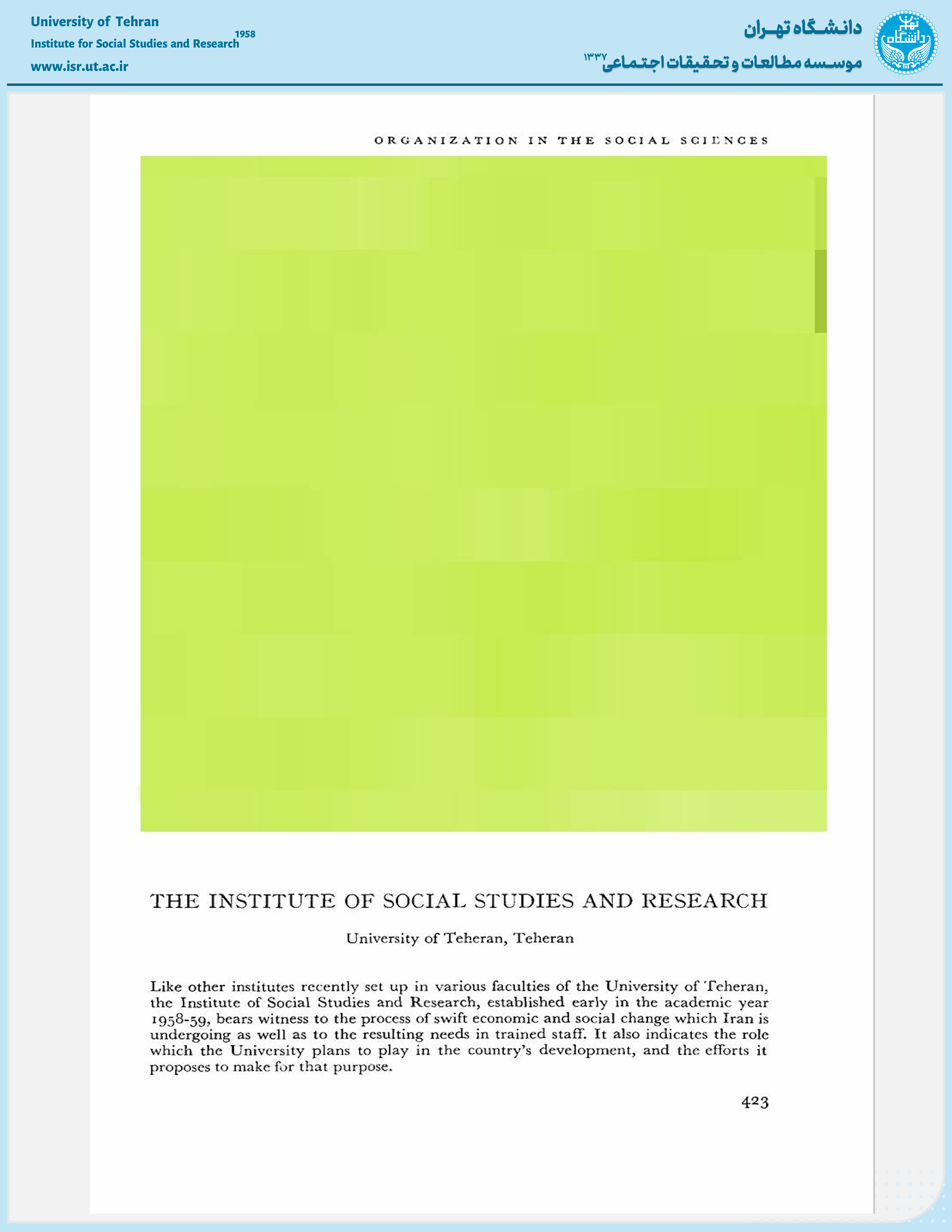
The Institute of Social Studies and Research, like several other institutes recently established within the various faculties of the University of Tehran, was founded at the beginning of the 1958–1959 academic year. Its establishment was a clear indication of the rapid economic and social changes taking place in Iran and the resulting demand for trained personnel. It also reflected the role that the University of Tehran intended to assume in the country’s development and the efforts it was undertaking to that end.
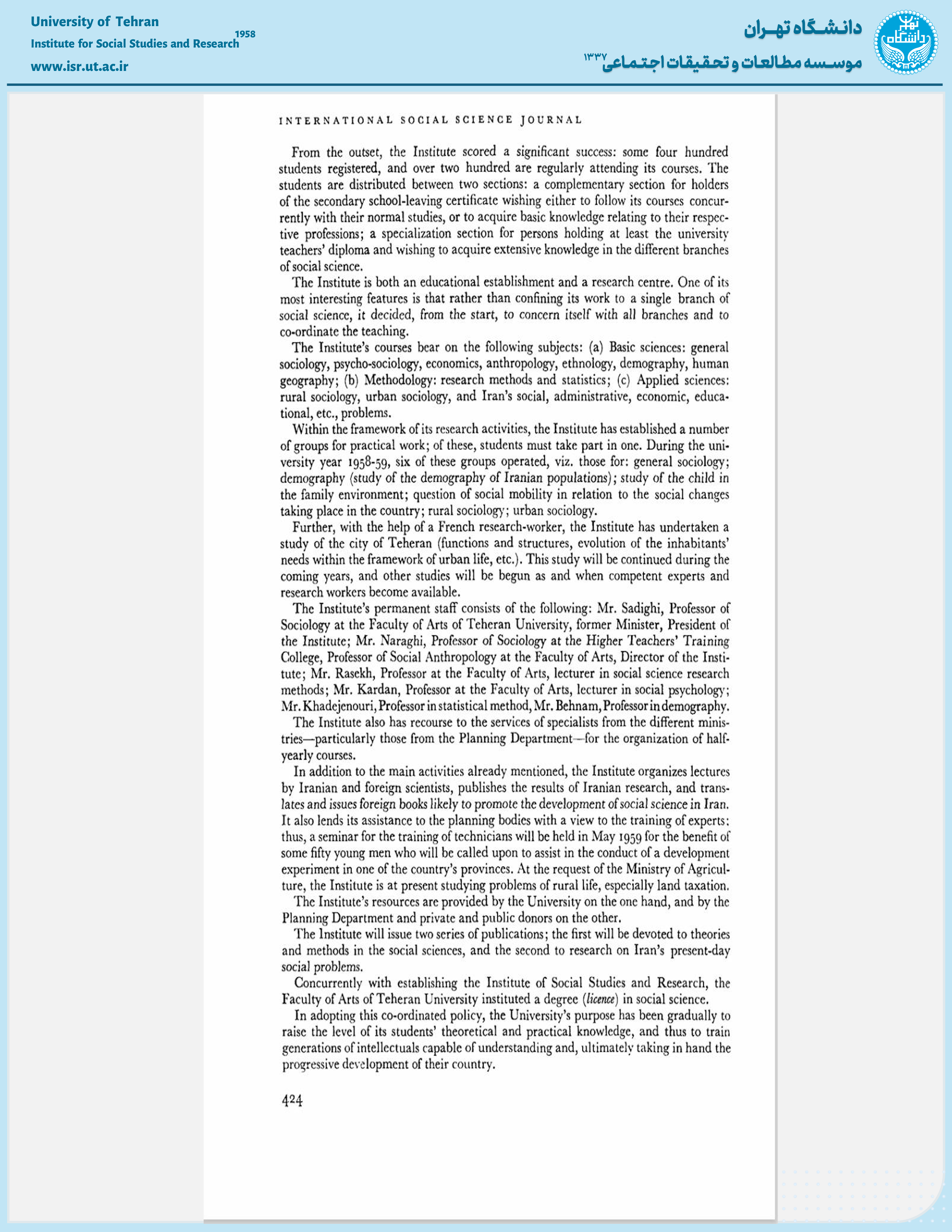
From the outset, the Institute achieved considerable success. Approximately 400 students enrolled, of whom more than 200 regularly attended classes. Students were admitted to two divisions. The first, the supplementary division, was intended for holders of secondary-school diplomas who wished either to attend courses alongside their regular studies or to acquire basic knowledge relevant to their professions. The second, the specialized division, was designed for those who held at least a university bachelor’s degree and wished to gain a broad understanding of the various branches of the social sciences.
The Institute serves both as an educational institution and as a research centre. One of its distinguishing features is that, from the beginning, it chose to cover all branches of the social sciences and coordinate their teaching rather than confining its activities to a single discipline.
The Institute’s curriculum covers the following subjects:
(a) Basic disciplines: general sociology, social psychology, economics, anthropology, ethnology, demography and human geography.
(b) Methodology: research methods and statistics.
(c) Applied disciplines: rural sociology, urban sociology, and the social, administrative, economic, educational and other problems of Iran.
As part of its research activities, the Institute has established several practical research groups, in one of which every student is required to participate. During the 1958–1959 academic year, six such groups were active in the following fields: general sociology; demography, with particular emphasis on the demographic study of Iran’s population; the study of children within the family environment; social mobility in relation to the social changes currently taking place in the country; rural sociology; and urban sociology.
In cooperation with a French researcher, the Institute has also begun a study of the city of Tehran, examining its functions and structures, changes in the needs of its inhabitants within the context of urban life, and related questions. This research will continue in the coming years, and further studies will be undertaken as soon as suitably qualified specialists and researchers become available.
The Institute’s permanent academic staff consists of Mr. Sedighi, Professor of Sociology at the Faculty of Letters of the University of Tehran, former minister and President of the Institute; Mr. Naraghi, Professor of Sociology at the Higher Teachers’ Training College, Professor of Social Anthropology at the Faculty of Letters and Director of the Institute; Mr. Rasekh, Professor at the Faculty of Letters and lecturer in social science research methods; Mr. Kardan, Professor at the Faculty of Letters and lecturer in social psychology; Mr. Khajeh-Nouri, Professor of Statistical Methods; and Mr. Behnam, Professor of Demography.
The Institute also draws on the expertise of specialists from various ministries, particularly the Plan Organization, to offer semester-long courses.
In addition to its principal educational and research activities, the Institute organizes lectures by Iranian and foreign scholars, publishes the findings of research conducted in Iran, and translates and publishes foreign books considered useful for the development of the social sciences in the country.
It also assists planning institutions in training specialists. For example, in May 1959, the Institute will organize a seminar for approximately 50 young technicians who are expected to participate in implementing an experimental development project in one of Iran’s provinces.
At the request of the Ministry of Agriculture, the Institute is currently studying issues relating to rural life, particularly land taxation. Its financial resources are provided partly by the University and partly by the Plan Organization and private and public donors.
The Institute plans to publish two series of publications. The first will be devoted to theories and methods in the social sciences, while the second will present research on contemporary social issues in Iran.
Alongside the establishment of the Institute, the Faculty of Letters of the University of Tehran has introduced a bachelor’s degree programme in the social sciences.
Through this coordinated policy, the University aims gradually to raise the theoretical and practical knowledge of its students and to educate successive generations of intellectuals capable of understanding and, ultimately, taking responsibility for their country’s ongoing development.
Reference
https://isr.ut.ac.ir/en/article/275634312

